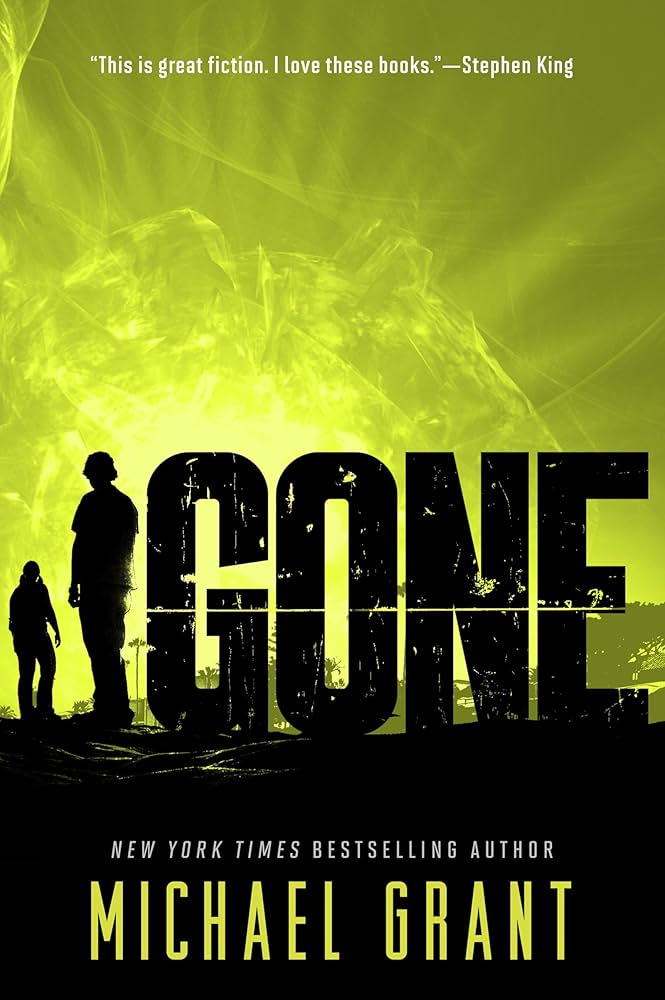
Like a long-time running successful and beloved television show I’ve been waiting for the right time to start because of the intimidating scope that turns out to not be worth the hype…yeah, that’s what I’d describe Gone as.
I’ve been eyeing Gone for years, and, well, the sheer size of the series was intimidating. Six books? And spinoffs? For a story about all the adults disappearing? I generally like when stories are franchises, but what would stretch that sort of story to that many books? Only now am I taking the first step to finding an answer. I have kind of an answer now.
So the start of Gone is the start of the blip. One second ago, 14-year-old Sam was watching his teacher give a lesson at the chalkboard, and then the next, his teacher wasn’t there anymore. Nor were there any adults and even some of the teenagers. What’s even weirder, if there could be such a thing, is there’s a barrier-esque wall around his little California neighbourhood that was never there before and burns to the touch really badly.
And not just that, some of those remaining are also disappearing. What is going on? And until the survivors can figure it out, all of which are at most young teenagers, how will they manage to feed themselves? Keep the power on? Take care of the babies and toddlers? Maintain order? Especially since some of these kids are showing unique abilities – and not all of them are up for peace and goodwill.
I think that description I gave makes this book sound epic. And the series is a big phenomenon at this point. So maybe it’s just that Book 1 was the preluding start.
One of my favourite books as a teenager was Lord of the Flies, and I think about the predicament those boys were in all the time. Finally deciding to pick this up, I was hoping for a new take on the formula, and I got that. In fact, I’m somewhat interested in how these characters will continue with their survival.
I myself am guilty of this in my books, but I have to say that a lot of this first book is quite slow-paced and even a little aimless. The culprit of this is primarily the storytelling method Grant goes with; we get with every new chapter a different but chronological point in time. And with each new time, we bounce from different points of view, keeping ourselves in the loop with as many people as possible.
The problem is that after a while, we wish we could just stick to a single story thread for a bit, and it becomes clear there’s too many conflicts to juggle. I would’ve liked the book more if it let us digest these individual stories more separately. Or just have one or even two points of view, not…however many there are. We find out there’s a bit of a timer our main hero is on, and that’s why every chapter starts with a timeframe that gets shorter and shorter, leading us to the big finish. But it’s not enough to forgive how the storytelling method just turns cluttered. When we near the big finale, we hear from the antagonists, gearing up to fight, and instead of excitement, I felt a prime example of how this book could’ve shaved off about 100 pages.
I’m somewhat interested in continuing this series, and if I do, hopefully with everything more established, the stories will have some more focus.
My grade: 2 stars out of 5

 William J. McGinn
Leave a comment