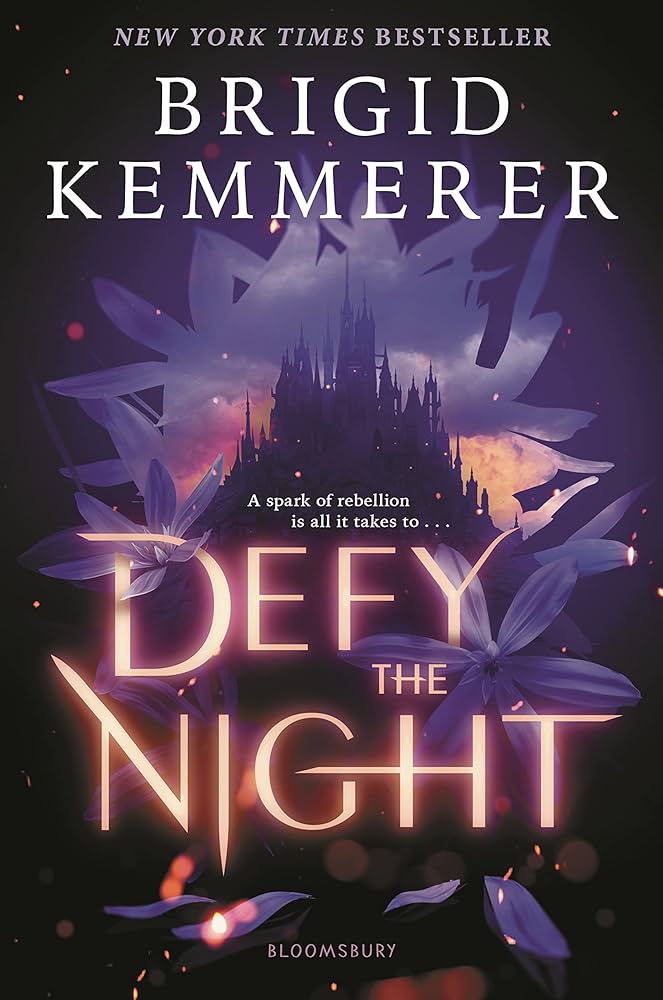
I was hooked from the get-go on Defy The Night, the first book in a trilogy and the first I’ve read from Brigid Kemmerer. If books like these were assigned to high schools instead of the usual dinosaurs like The Great Gatsby or Wuthering Heights, more kids would definitely love to read.
Imagine Robin Hood crossed with Breaking Bad alongside a tinge of Lord of the Rings and you’ve got this. We have two side-by-side heroes; Tessa, an orphan whose parents were slaughtered by the law enforcers of Kandala who answer to the kingdom, and Wes, a masked guy who actually has never shown Tessa his face, for personal and professional safety. Both of these two really know their community, and there is an illness that has descended upon them all. The only known elixir is manageable with these Moonflower petals, but supply is down and there never seems to be enough for the general population, but more than enough for King Harristan, Prince Corrick, and the rest of the royal palace.
The reason Tessa’s parents were killed is they were caught doing some black market manufacturing, cooking up the cure and distributing it to those who couldn’t afford it. Now Tessa and Wes have taken over their cause. As things get tougher and tougher, the pair find themselves in an even more unfortunate pickle, at the very mercy of the King, but maybe their expertise can be of use.
That’s a pretty simplistic explanation, but there’s a twist in all of that I will not spoil. You might think the book sounds pretty typical, but it has two things that bring it above the usual dystopia, and I am a huge fan of dystopia books – first of all, most of the first-class characters aren’t actually as heartless as they are made out to be. They’re pragmatic, and we want them to be more courageous, but people we may originally root to be attacked we might not actually want harmed by the end. And they’re a bit more layered than the usual socialite – maybe they’ve also got their hands tied, being blackmailed into keeping quiet. Second of all, and this is bigger – we really learn about the economics of Kandala and the distribution of the elixir – where they’re grown, leaders putting sanctions on their material, and like I said before, some leaders being or feeling trapped. Brigid Kemmerer has created a universe with a virus, and has set up a broken system that really feels believable. I haven’t read many books that are both this smart and so fascinated with themselves.
There’s discussion about how a revolution wouldn’t actually fix the problem, but that’s a part that could do with some more discussion. At the very least, the rulers aren’t so obscenely wealthy that redistribution of all their wealth would fix everything. In this real world of ours, if we took back the trillions of dollars from the billionaires of the world and rebuilt our broken systems from the ground up, world hunger and poverty would not entirely be vanquished, but we would be able to create a world where millions would not die and would not go hungry and many more would be stable. You know it’s true. The world in this book and its political clashes are not quite the same, but they’re similar enough to not only feel like this is realistic and sophisticated, but to really wonder what the best solution could be. And it’s all told in a fast-paced, frightening roller coaster way of storytelling.
Kemmerer writes in a way where you really feel the pain. There are executions, both public and private, and all of which feel unfair, grim, and despicable. There’s poverty that is manufactured and naturally occurring at the same time. There’s a rebel group I can’t wait to learn more about. There’s two more books in this series, and I hope she keeps the momentum. This series may have the potential to be a new favourite for me.
My grade: 4 and a half stars out of 5


Leave a Reply